Why the Thames Should Stop Chasing Monaco and Build Its Own Superyacht Format
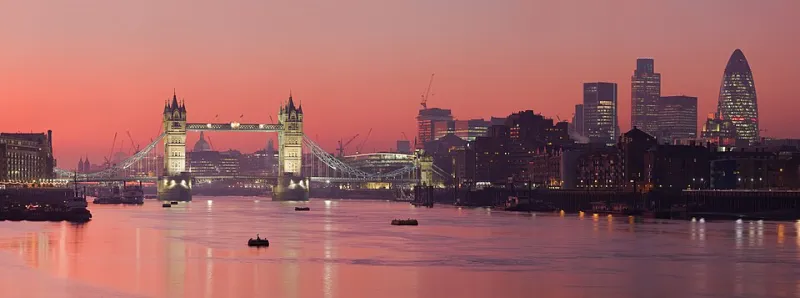
Photo: Diliff, CC BY 3.0, via Wikimedia Commons
London is, by most reasonable measures, one of the world's great centres of superyachting. The brokers, the insurers, the class societies, the naval architects and a very substantial share of the buyers are all here. What the capital has never had is a showcase to match. The question is not whether London should stage a superyacht event. It is whether the city should keep measuring itself against Monaco when the river beneath it makes that comparison largely meaningless.
Three Rivals, Three Different Machines
Monaco, Cannes and Fort Lauderdale are routinely cited as the benchmark, and each works for a reason that cannot simply be copied.
Port Hercule is a sheltered, purpose-built harbour with negligible tidal movement. The show effectively rebuilds the quays for a fortnight and dismantles them afterwards. The water is deep, calm and controlled, and the entire display sits within a short walk of the hotels where buyers stay.
Cannes uses the Palais des Festivals and the adjoining quays in much the same way, with the added advantage that larger vessels can lie offshore and be visited by tender, keeping the waterfront uncluttered.
Fort Lauderdale is a different proposition again: a vast in-water display, a canal network that permits demonstration runs, and a domestic market so dense that a buyer can fly in, view three yachts and be home the same evening.
Each of these events is a product of its geography. Monaco's advantage is a harbour designed for the purpose. Fort Lauderdale's is a marine industry clustered along a navigable waterway. Cannes' is a convention centre with a quay attached to it.
The Thames Is Neither Harbour Nor Marina
The Thames is a working tidal river and it behaves like one. Spring tidal range at London Bridge runs to roughly seven metres, which means any vessel alongside must either rise and fall on a floating pontoon or accept a constantly shifting fender angle. The current is strong, the water carries debris after rain, and wash from commercial traffic is a permanent consideration.
Above Tower Bridge, bridge heights and air draught effectively cap what can pass, and the pool of water available for any display is limited. Serviced berths in central London for vessels much beyond 30 metres are very few, and those that exist are booked years ahead. The Port of London Authority quite properly regulates movements on a busy commercial waterway, and no organiser can close a stretch of it for a fortnight on a whim.
Add the practicalities — crew accommodation, provisioning, generator noise, security, and the cost of moving a fleet in and out on a tide — and the case for a Monaco-style in-water show on the Thames collapses. Attempting it would be expensive, constrained and, most probably, short-lived.
The Alternative: A Pavilion With Water Attached
None of which argues against London. It argues for a different format.
A curated pavilion on land, with a modest and carefully chosen afloat element, would play to the city's strengths rather than fighting the river. The site would need four things: a quay with pontoon access capable of handling a small number of vessels in the 20 to 40 metre band, a building of genuine quality for exhibitors and hospitality, sound transport links, and somewhere nearby for demonstration runs.
The Royal Docks, the Greenwich Peninsula and the stretch around the ExCeL campus each offer most of this. A site of that kind could accommodate twelve to eighteen yachts by invitation, a shore-side exhibition of design studios, brokers, naval architects and equipment makers, and a programme of on-water demonstrations by tender and day boat — the category, incidentally, in which British yards excel.
What London Actually Owns
The supply chain is here. The United Kingdom is home to production yards of real scale, a tender manufacturer whose products are specified on yachts worldwide, a cluster of naval architecture practices, the class societies, the marine insurance market, and a legal and financial services sector that structures a great many of the world's ownership arrangements.
The audience is here too. The south-east holds a concentration of wealthy residents unmatched anywhere in Europe, and the international buyer traffic through London's private aviation terminals is constant.
What has been missing is a format that places those two things in the same room without asking the river to perform tricks it cannot perform.
The Joining-Up Is the Point
A London event should not be a boat show with a car park attached. It should be a luxury-mobility exhibition, and the capital is unusually well placed to deliver one.
A private aviation lounge, a shuttle service to London City Airport and to the principal Farnborough and Biggin Hill operators, and a curated display of prestige cars on the quay would connect the three categories that the same buyer considers in the same quarter. A visitor who arrives by air, views a yacht by appointment and leaves in a chauffeured car has experienced a single proposition rather than three unrelated exhibitions.
That is the advantage Monaco cannot easily match and Fort Lauderdale does not attempt.
What a Credible First Edition Looks Like
- A late-June or early-September date in 2027, avoiding the Mediterranean charter peak and the school holidays.
- An invitation-only afloat list, judged on quality rather than quantity.
- A pavilion with a strong design and technology strand — hybrid and electric propulsion, hydrogen research, lightweight materials — where British engineering can be shown properly.
- A scheduled demonstration programme on the water, ticketed by appointment.
- A private aviation and chauffeured mobility lounge, linked to the show by shuttle.
- A single, relatively high ticket price rather than a volume-footfall model.
The Measure of Success
The right metric is not gate numbers. It is orders placed, mandates signed and relationships formed — the things a curated event exists to produce. On that test, London does not need to be Monaco. It needs to be itself, and to do it properly.